Key Takeaways
- GRC convergence links governance, risk, and compliance through shared structures.
- Controls, risks, and obligations connect instead of living in silos.
- Evidence can support multiple oversight needs at once.
- Integrated GRC describes similar efforts using shared data and workflows.
- The term is descriptive, not a formal framework.
What is GRC Convergence?
GRC convergence describes an approach to organizing governance, risk, and compliance activities so they operate through shared structures rather than as separate, parallel programs. It is not the name of a formal framework or regulatory concept. It is a descriptive term used to explain how organizations align oversight, risk management, and compliance work within a more connected operating model.
There are a few similar ideas often described as integrated GRC or integrated governance, risk, and compliance, which also aim to reduce silos and improve structural alignment across these functions. While the wording varies, the underlying focus is the same: connecting related oversight activities through shared definitions, data, and workflows.
How Governance, Risk, and Compliance Became Disconnected
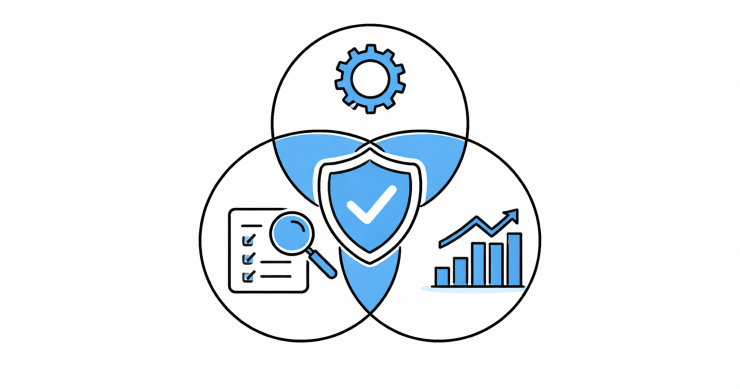
Governance, risk, and compliance did not develop as a single discipline.
Governance functions grew from corporate oversight, board accountability, and policy management. Risk management evolved through financial, operational, and enterprise risk practices. Compliance programs are formed in response to specific laws, regulations, and industry standards. Security, privacy, legal, and internal audit teams expanded alongside them, each with its own expertise, systems, and reporting lines.
Over time, this led to:
- Separate tools and platforms
- Different interpretations of similar controls
- Independent evidence collection processes
- Distinct reporting cycles
GRC convergence addresses that structural separation by moving toward what many describe as an integrated governance, risk, and compliance model.
What Convergence Changes
Convergence is less about organizational charts and more about how work is defined and connected.
In a converged model:
- Controls are defined once and referenced across multiple frameworks
- Risks are linked to the controls designed to manage them
- Regulatory and contractual obligations map to the same control structure
- Evidence collection supports multiple oversight needs at the same time
- Issues and remediation activities are tracked in a way that reflects both risk impact and compliance relevance
This structure creates continuity between governance requirements, risk management, and compliance activities. Instead of coordination relying primarily on meetings and manual reconciliation, relationships between risks, controls, and obligations are built into the way information is structured. This type of alignment is often associated with integrated GRC, where oversight functions rely on shared foundations rather than separate interpretations.
Relationship to Integrated Risk Management
GRC convergence overlaps with ideas found in Integrated Risk Management (IRM). IRM focuses on bringing different risk disciplines together so organizations can evaluate and report risk consistently at the enterprise level.
Convergence and integrated governance, risk, and compliance approaches extend this alignment beyond risk reporting into the operational layer. They connect governance requirements, compliance obligations, control testing, and evidence management into a shared structure.
Practical Signs of Convergence
Organizations typically move toward convergence gradually. It becomes visible through changes in structure and practice.
Common indicators include:
- A shared control library used across risk, compliance, and security functions
- Central mapping of regulations and standards to those controls
- Risk assessments that reference existing control structures
- Control testing results are reused for both compliance and risk purposes
- A unified system for tracking issues, findings, and remediation
- Leadership reporting built from a consistent, cross-functional data foundation
These elements reduce duplication and make oversight activities easier to trace and explain, which is a core objective of integrated GRC efforts.
What Convergence Is Often Mistaken For
Some changes resemble convergence but do not create the same structural alignment.
Examples include:
- Shared dashboards built on different underlying data sources
- Reorganized departments without changes to workflows or control definitions
- Standardizing framework lists, while controls are still interpreted differently by each team
Convergence depends on shared definitions, mappings, and evidence structures. Without those, alignment remains surface-level, even if the organization describes its approach as integrated.
Early Steps to Convergence
Organizations often start by focusing on common structure before technology.
Typical early steps include:
- Defining a common control set
- Mapping major regulations and standards to that set
- Linking enterprise risk categories to the same control structure
- Aligning testing methods so results can be reused
- Centralizing issue and remediation tracking
About the Terminology
“GRC convergence” is not an official industry designation and does not appear as a defined concept in regulatory texts or formal standards. Organizations may use different language, including integrated governance, risk, and compliance, integrated GRC, or references to Integrated Risk Management, to describe similar efforts.
Longer phrases, such as GRC integrated risk management or GRC integration risk management, are sometimes used to reflect how GRC practices intersect with enterprise risk management, but these are descriptive expressions rather than standardized categories.
The value of this terminology lies in helping explain a structural shift in how governance, risk, and compliance activities are linked.
The Outcome of Convergence
When convergence takes hold, the organization gains a clearer line of sight between obligations, risks, controls, and evidence.
Leadership can see:
- Which controls address which requirements
- How risks connect to those controls
- What evidence demonstrates control performance
- How issues affect both risk exposure and compliance posture
FAQs
How does convergence support executive reporting?
When risks, controls, and obligations are mapped within a single structure, leadership reporting can draw from consistent data rather than reconciled inputs from separate functions.
Does convergence change how controls are tested?
Testing methods may stay the same, but results are structured so they can support multiple purposes, such as compliance validation, risk evaluation, and audit evidence.
How does convergence affect third-party risk management?
Shared control structures allow third-party risks, compliance obligations, and control assessments to be evaluated within the same oversight model.
Does convergence eliminate functional boundaries?
No. Governance, risk, compliance, and audit functions retain their roles and expertise. Convergence aligns how their work connects, not who is responsible.
How does convergence help with evidence management?
Evidence collected for one purpose can be reused across multiple oversight activities when it is tied to shared control definitions.